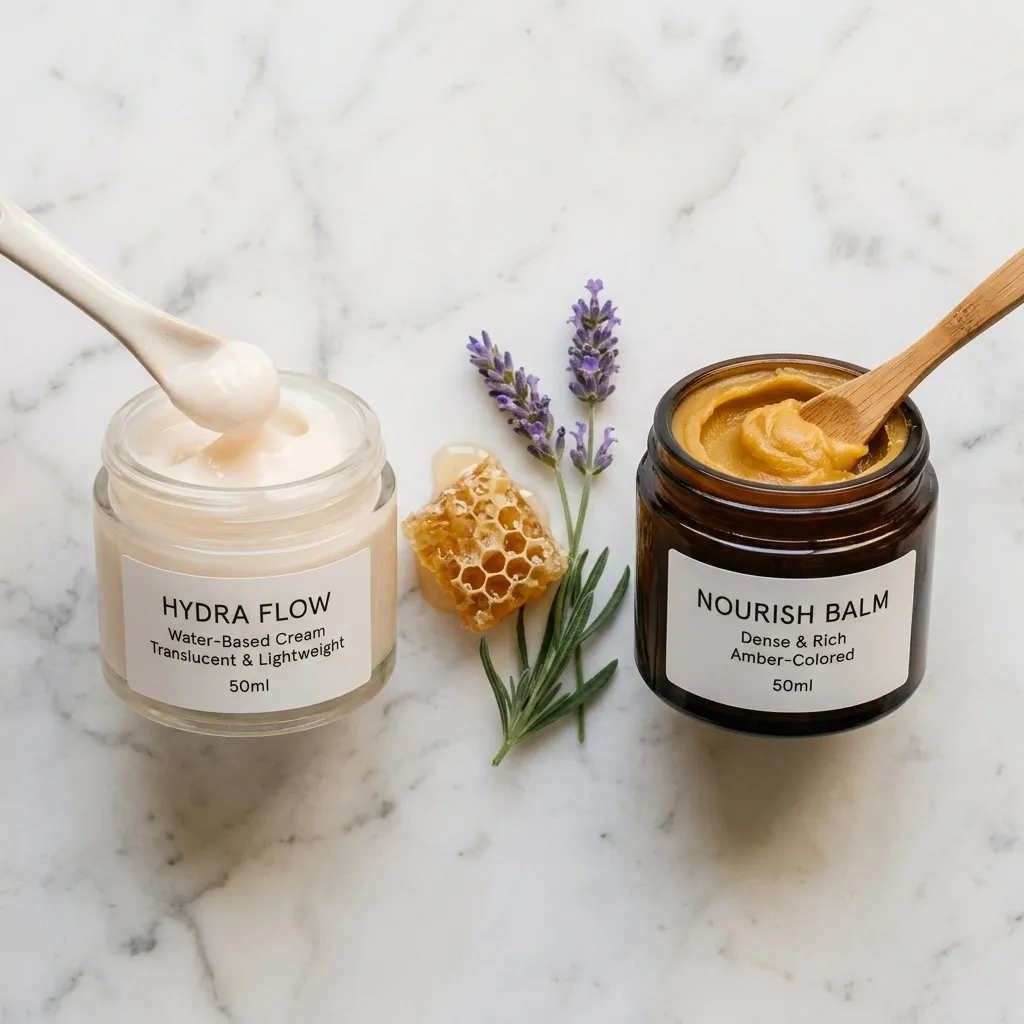
When I first began formulating, I remember holding two jars side by side on my worktable.
One was a conventional cream, pale and airy. The other was a dense balm made of oils and beeswax. They looked similar in purpose. They both promised moisture. But structurally, they were entirely different.
That difference begins with water.
Water as the Foundation
Most conventional skincare products are primarily composed of water. If you look at an ingredient list, you will often see "water" or "aqua" listed first. Ingredients are listed in descending order by concentration, so this tells us that water makes up the largest percentage of the formula.
There are practical reasons for this.
Water is an excellent solvent. Many beneficial ingredients, such as glycerin, niacinamide, peptides, and certain botanical extracts, dissolve in water. Water allows these ingredients to be delivered in a lightweight, easily spreadable texture. It creates creams and lotions that absorb quickly and feel refreshing on the skin.
There is nothing inherently wrong with this. It is simply how emulsified skincare has evolved.
How Water Changes the Formula
But water changes the structure of a formula in important ways.
Oil and water do not naturally stay mixed. To create a smooth cream, formulators must add emulsifiers. These molecules bind oil and water together, creating a stable emulsion. Because water also creates an environment where microbes can grow, preservatives are required as well. The final product becomes a carefully balanced system of water, oils, emulsifiers, preservatives, and actives.
It is a layered architecture.
Water-based creams can provide immediate hydration because water content increases the moisture level in the upper layers of the skin. Humectants within the formula draw additional water into the stratum corneum. The skin can feel plump and smooth quickly.
But Water Evaporates
If the skin's lipid barrier is not sufficiently supported, transepidermal water loss continues. The temporary plumpness may diminish within hours. This is not a flaw in the product. It is simply physics and biology interacting.
In contrast, water-free formulations remove that aqueous phase entirely. When I create a balm composed of plant oils and beeswax, there is no water to dilute the ingredients. There is also no need for emulsifiers or traditional preservatives designed for water-based systems.
They do not hydrate in the same way a water-based serum does. Instead, they help the skin retain its existing moisture more effectively.
This difference often surprises people.
Softness Beyond Water
We have been conditioned to associate moisture with water. But softness and resilience depend just as much on lipid integrity as they do on hydration. A water-based cream can feel immediately refreshing. A well-formulated balm can feel quietly protective.
Both approaches serve different purposes.
Some climates and skin types respond beautifully to lighter emulsions. In humid environments, where water loss is less aggressive, water-based creams may feel entirely sufficient. In dry climates, or for mature and barrier-compromised skin, lipid-focused formulations can offer a deeper sense of stability.
A Lesson from the Hive
My choice to work without water is not a rejection of conventional skincare. It is a philosophical decision rooted in what I have observed in the hive.
Beeswax does not contain water. It creates structure that preserves what is inside. Honey itself contains water, but it remains stable because the architecture around it protects that balance. Structure determines longevity.
At Goodfriend Honey Co., I formulate with that principle in mind. By removing water, I remove dilution. Every ingredient has a structural role. The balm does not rely on quick absorption or immediate plumping. It relies on reinforcing the barrier and slowing unnecessary loss.
Instead of asking how much hydration I can add, I ask how well the skin can hold what it already has. And in my experience, that question changes everything.