If you have spent any time outdoors in Florida, particularly along the Gulf Coast from Sarasota down through Bradenton and the barrier islands, you have met them. You may not have seen them. But you felt them.
They are the reason a beautiful sunset on the lanai can turn into a swatting frenzy. They are why your ankles look like a connect-the-dots puzzle after an evening walk. And they are one of the most frequently asked-about topics at our farmers market booth, right after "Is your honey really raw?"
What Exactly Are No See'ums?
No See'ums are biting midges from the family Ceratopogonidae. They are tiny, often less than one-sixteenth of an inch long. That is small enough to pass through standard window screens, which is why you sometimes feel bites inside your own home during peak season.
Only the females bite. Like mosquitoes, they need a blood meal to produce eggs. They find you by detecting the carbon dioxide you exhale, your body heat, and the lactic acid in your sweat. Once they land, they use saw-like mouthparts to tear into the skin and inject saliva containing anticoagulants to keep your blood flowing.
Unlike mosquitoes, which often inject a numbing agent before biting, no see'um bites can be immediately painful. You feel a sharp, burning pinch and look down to see nothing. Hence the name.
Why Florida Is Their Paradise
No See'ums breed in damp soil, mud, salt marshes, and decaying organic matter. Florida's coastal wetlands, mangrove shorelines, and humid subtropical climate provide ideal breeding conditions year-round. Sarasota and Manatee counties, with their proximity to the Gulf, bays, and brackish waterways, are particularly active zones.
They are most aggressive at dawn and dusk when the air is calm and humidity is high. A still evening with no wind is their prime feeding window. If you have ever sat outside at sunset and noticed tiny clouds of insects hovering near your legs, those were likely No See'ums positioning for a meal.
Wind is their weakness. They are extremely poor fliers. Even a moderate breeze or a well-placed fan can keep them at bay. But on calm evenings, they are relentless.
Why Most Repellents Fall Short
Many commercial insect repellents are formulated primarily for mosquitoes. DEET-based sprays can help, but they come with a chemical load that many people prefer to avoid, especially when applying to children or using daily. Picaridin is another synthetic option that works but carries the same concerns for people seeking cleaner alternatives.
The challenge with No See'ums specifically is their size. They can land on skin between spray applications and bite before you even notice them. A liquid spray evaporates, often within an hour or two. That leaves gaps in coverage, and No See'ums exploit those gaps.
How Our Bug Bar Works
When I started getting eaten alive at my own hives, I knew I needed a solution I could trust. I was not going to spray synthetic chemicals on my skin and then handle beeswax and honey. So I formulated the Bug Bar.
The Bug Bar uses the same ultra-moisturizing base as our solid lotion bars: beeswax, cocoa butter, mango butter, shea butter, apricot kernel oil, grapeseed oil, and avocado oil. Then it layers in seven essential oils chosen specifically for their insect-repelling properties:
- Lavender calms the skin while creating a scent barrier insects avoid
- Lemongrass is a proven natural deterrent for mosquitoes and midges
- Geranium disrupts the scent signals insects use to locate hosts
- Peppermint creates a cooling sensation and strong aromatic barrier
- Cedarwood repels a broad range of biting and stinging insects
- Rosemary adds another layer of aromatic deterrence
- Oregano contributes antimicrobial and anti-inflammatory support
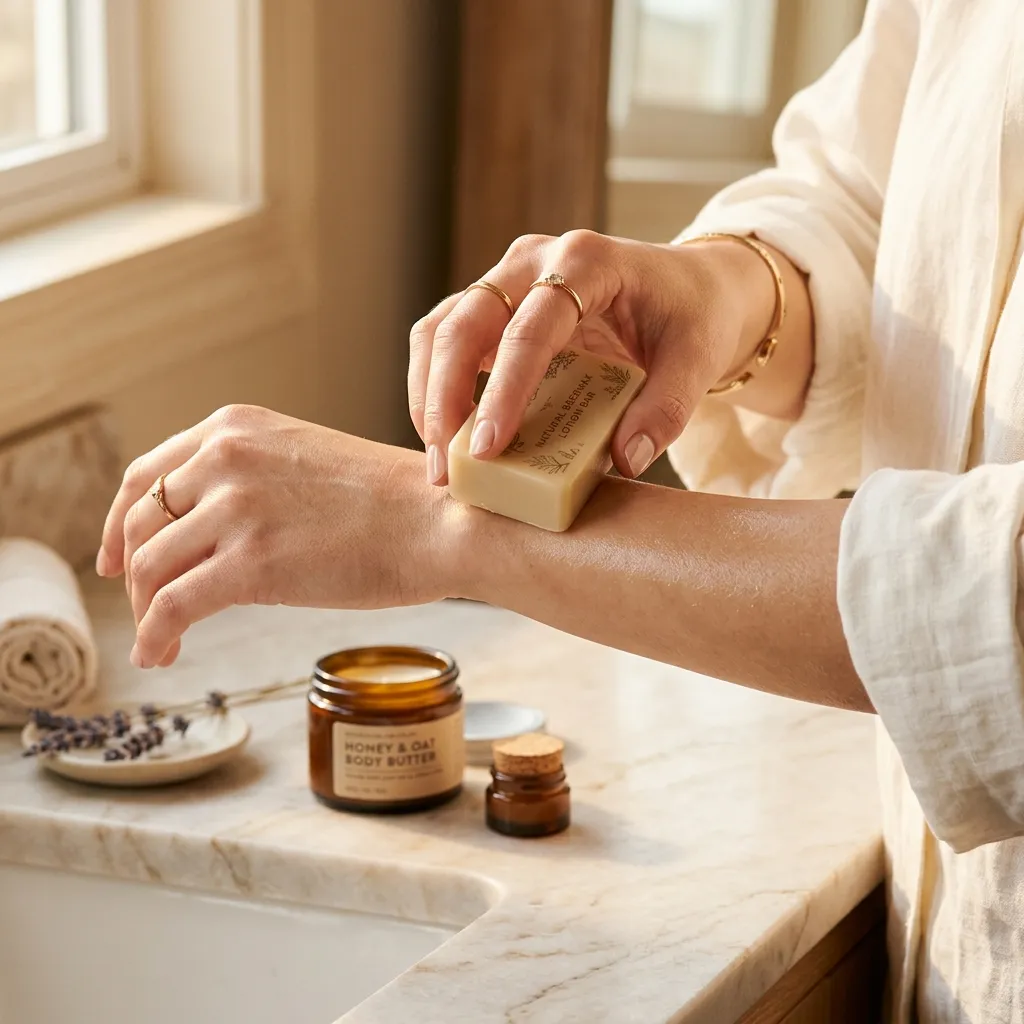
The key difference between the Bug Bar and a spray is the delivery system. When you warm the bar between your hands and rub it onto exposed skin, the beeswax creates a physical barrier that sits on the surface. It does not evaporate the way a liquid spray does. That barrier holds the essential oils close to the skin for hours, maintaining a consistent scent shield that insects actively avoid.
After the Bite: Relief, Not Just Prevention
Here is where the Bug Bar separates itself from every spray on the market. If you forget to apply it and do get bitten, you can rub a small amount directly onto the bite.
The lavender, peppermint, and oregano essential oils in the formula have natural anti-inflammatory and soothing properties. They help reduce the histamine-driven itch and calm the swelling around the bite. The cocoa and shea butters moisturize the irritated skin, and the beeswax seals in that relief so you are not reapplying every fifteen minutes.
It will not erase a bite, but it takes the edge off considerably. Many of our customers keep one in their purse or tackle box specifically for after-the-fact relief.
Non-Toxic, Safe for Everyone
The Bug Bar contains no DEET, no synthetic chemicals, no artificial fragrances, and no preservatives. It is safe for children, safe for sensitive skin, and safe to use daily. Every ingredient is something you could identify and pronounce.
For anyone who spends time outdoors in Florida, whether you are gardening, fishing, walking the dog at dusk, or just trying to enjoy your backyard, the Bug Bar was designed for your life here.
The No See'ums are not going anywhere. But you do not have to let them ruin your evening.